
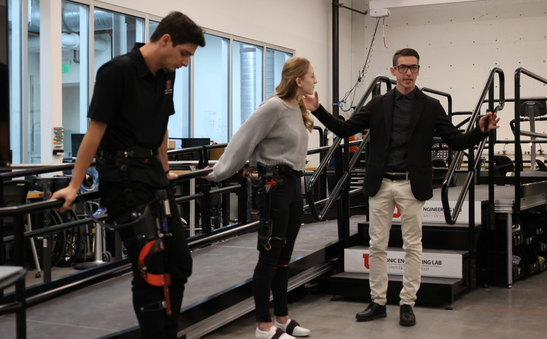
Dr. Tommaso Lenzi
Ergonomics and Safety
FRR 2147765 J. Abbott (PI), T. Lenzi (co-PI), S. Roundy (co-PI)
National Science Foundation (NSF) - Foundational Research in Robotics
01/01/2023-12/31/2026 -- $754,000
This award explores a novel enabling technology for next-generation robots that are agile, efficient, and that safely interact with humans: the magnetic cogging parallel-elastic actuator (MC-PEA). The MC-PEA is particularly promising for use in robotic legs, including prostheses, exoskeletons, and the legs of autonomous robots such as humanoids and quadrupeds. The MC-PEA comprises an electric motor connected in parallel with a passive magnetic cogging-torque element (CTE). The defining characteristic of the MC-PEA is that it has a discrete, controllable-by-design set of stable equilibria created by strong passive magnetic springs. No energy is required from the motor to simply hold a static load. Rather, bursts of energy are required to cause the CTE to cog over to a neighboring equilibrium. The MC-PEA will efficiently implement bioinspired motion primitives, including multiple resonance modes that will lead to efficient oscillatory movements required during walking and running. The MC-PEA will represent an energy-efficient alternative to the ubiquitous series-elastic actuator (SEA) in applications in which the SEA is currently the go-to solution. In addition, this award will support training and mentorship of graduate students, inclusion of undergraduate students in research, and improvements to teaching curriculum.
The objective of this project is to characterize the natural and forced dynamics of the MC-PEA and determine how to control it effectively and efficiently for robotic motions. The work will improve understanding of the performance specifications of an optimally designed MC-PEA across potential parameter variations. The benefits of the MC-PEA will be explored through application in powered ankle prosthesis and legged robots. The approach includes investigation of bioinspired dynamic motion primitives — including impedance control, point-to-point sub-movements, and oscillations — using a two-link robotic leg with a simple point-like foot and with MC-PEAs powering the hip and the knee. The research also includes development of custom energy regeneration circuits that can be rapidly switched on and off to enable energy to be reclaimed during dynamic movements. The project outcomes will be the optimal parametric designs of the magnetic cogging-torque element (CTE) for a wide variety of step sizes, to be disseminated to robot designers.


 © 2026 Rocky Mountain Center for Occupational and Environmental Health