
Dr. Tommaso Lenzi
Ergonomics and Safety
Faculty Early Career Development (CAREER) Award (FRR-2046287), T. Lenzi (PI)
National Science Foundation (NSF) - Foundational Research in Robotics
05/20/2021-05/19/2026 -- $584,000
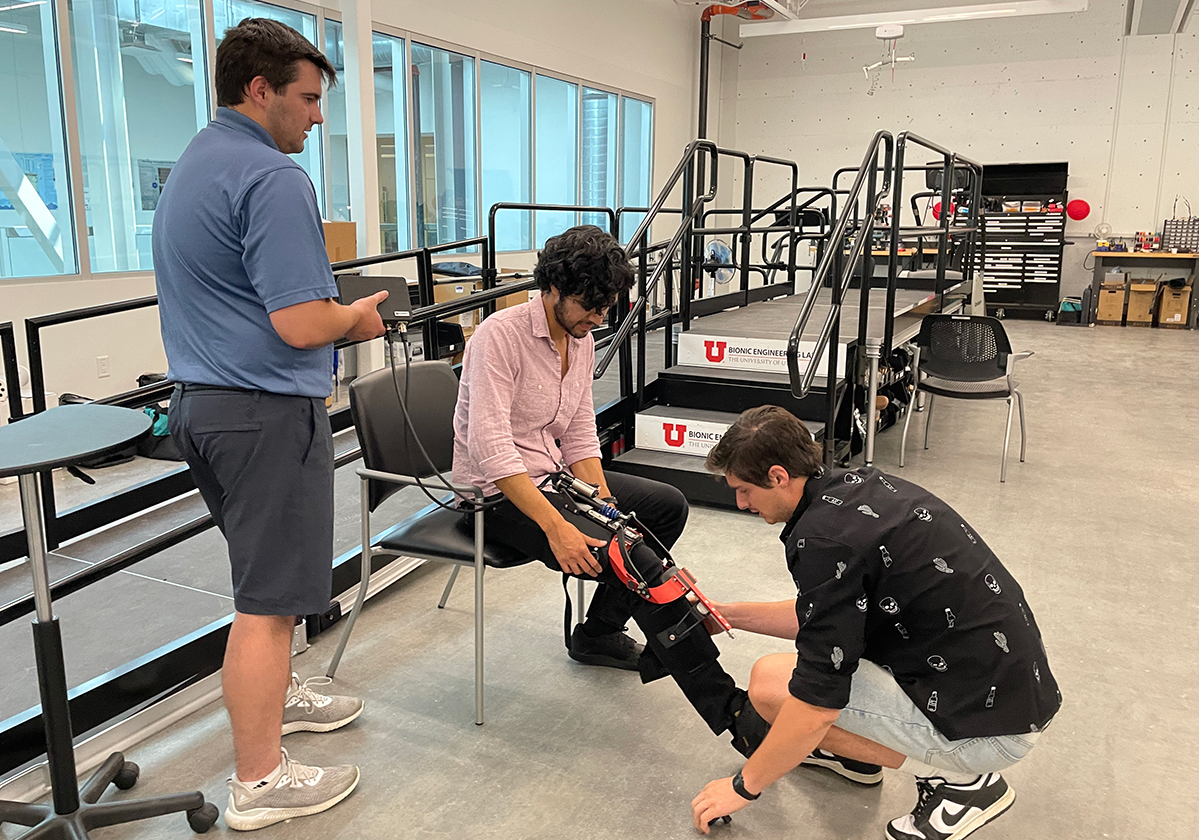
Wearable robots, such as powered exoskeletons, promise to improve our productivity, health, and independence by augmenting, preserving, and restoring our ability to move. However, existing powered exoskeletons are heavy and inefficient, which largely prevents them from being used in real life. Existing powered exoskeletons apply assistance to each wearer's joint separately, which requires many actuators and large batteries. In contrast, the powered exoskeletons created in this project use bio-inspired actuation systems that concurrently assist multiple joints, much like human muscles. Our multidisciplinary research team of roboticists, movement scientists, and clinicians works closely with individuals with disabilities, broadening the participation of underrepresented groups in research and positively impact engineering education.
Ambulation requires considerable energy to accelerate and decelerate the limb segments and to dynamically support the body against gravity. Human ambulation is highly efficient and stable because of the passive dynamics of the leg and the elastic properties of the muscles, and also because many muscles span multiple joints, actively transferring energy between joints. In contrast, existing powered exoskeletons are designed and controlled considering each actuated joint as a separate unit, independent from the others, even when multiple joints are actuated. This approach disrupts the natural dynamics of ambulation, resulting in less efficient and less stable gait. The goal of this project is to address this fundamental gap by developing energy-conserving mechanisms and control algorithms inspired by human ambulation. We seek to optimize the energy exchange across multiple joints for the design and control of powered exoskeletons by studying how humans adapt to the assistance concurrently provided by a powered exoskeleton to multiple leg joints, on different anatomical planes, or during different ambulation activities. We are designing powered exoskeletons that can allow for energy transfer between different joints, conserving energy within the system, while improving metabolic cost, muscle effort, and stability of the wearer.
Publications:


 © 2026 Rocky Mountain Center for Occupational and Environmental Health